
Porto VCI truck ban: what changes in the choice of warehouses and industrial land
Since 15 September 2026, heavy goods vehicles have been banned from the VCI between 07:00 and 21:00. The measure structurally alters the location equation for any company that depends on road freight transport in the Northern region.
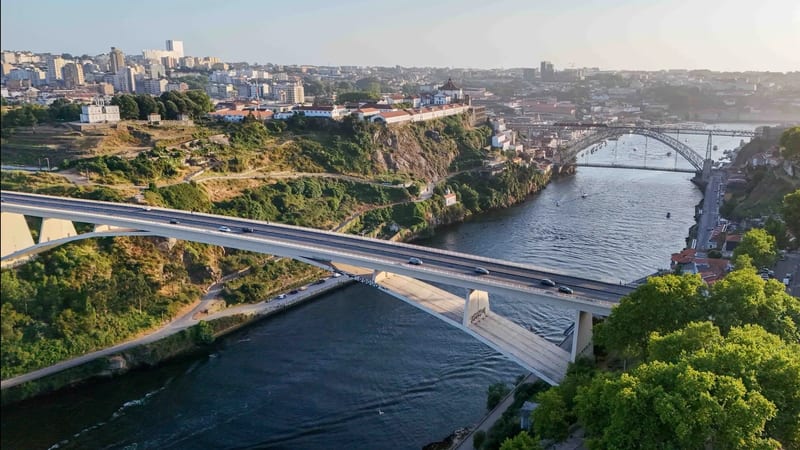
Since 15 September 2026, heavy goods vehicles have been banned from travelling on Porto's Via de Cintura Interna (VCI) between 07:00 and 21:00 on weekdays.
The VCI is Greater Porto's main ring road — 23 kilometres crossing Porto and Vila Nova de Gaia, with more than 132,000 vehicles per day. The measure removes approximately 4,500 lorries daily from the road, a reduction of around 60% of heavy traffic.
The imposed alternative is the Circular Regional Externa do Porto (CREP/A41), toll-free for heavy vehicles, but which in some routes represents a detour of more than 60 kilometres per operation.
The direct impact on logistics operations
For transport and logistics companies operating in the Northern region, the consequences are immediate:
Increase in operating costs. More kilometres mean more fuel, more driver hours and more vehicle wear. This additional cost tends to be reflected in transport rates and, along the supply chain, in prices paid by the end consumer.
Operational unpredictability. The licence plate registration platform for exceptions — which allows heavy vehicles with origin or destination in Porto and Gaia to travel on the VCI — only went live on the eve of the ban. Not all companies were prepared to manage this process immediately.
Pressure on the Valongo logistics corridor. Greater Porto already had an availability rate of just 0.5% in the first half of 2026. The reconfiguration of supply routes will increase pressure on locations with direct access to the CREP, especially the Valongo corridor, which concentrated 67% of regional logistics occupancy in the same period.
What this means for those seeking industrial or logistics space in Greater Porto
The VCI ban is not merely an urban mobility measure. It is a factor that structurally alters the location equation for any company that depends on road freight transport in the region.
1. Location becomes even more valuable
In a market already characterised by extreme supply scarcity, proximity to the CREP/A41 becomes an even more decisive selection criterion. Warehouses and land with direct access to this axis — such as the Valongo, Maia and Matosinhos corridors — gain additional operational relevance compared to locations that relied on the VCI as their main route.
2. Logistics costs enter the financial model
Companies that were evaluating spaces based primarily on rent per m² now need to incorporate additional logistics costs into their decision model. A seemingly cheaper warehouse in a less favourable location can become significantly more expensive when the route detours imposed by the new regulation are taken into account.
3. Location due diligence is more critical than ever
Location analysis is no longer a secondary criterion. Circulation restrictions such as this make accessibility due diligence as important as rent per m². Questions that were secondary until a few months ago are now decisive in the analysis of any industrial or logistics asset in Greater Porto.
4. The future pipeline will reflect this reconfiguration
The logistics pipeline planned for Greater Porto through 2027 totals approximately 69,000 m², of which 42% is already pre-let. Projects positioned alongside the CREP will attract demand more quickly, and developers who anticipate this reconfiguration will have a clear competitive advantage.
A measure with two years of uncertainty
Authorities estimate that at least two years will be needed to assess the real impact of the ban on VCI traffic. During this period, operational uncertainty will be a constant for companies that depend on this corridor.
What is certain from now on: location decisions made today in Greater Porto will live with this reality for years. Ignoring this factor in the analysis of an industrial or logistics asset is a risk that no occupier or investor should take.
How Tecton can help
At Tecton Industrial Partners, location and accessibility analysis is an integral part of our advisory process for occupiers and investors in the industrial and logistics sector.
If you are evaluating space in Greater Porto, talk to us.